I received a letter today from NPower Juice saying that they are aiming to increase their capacity to allow a further 50,000 homes to join. Juice accounts for a third of all green energy homes in the UK. This move would increase the total green energy homes in the UK by 30%.
The letter also says that Greenpeace are ending their partnership with NPower and no longer formally endorse Juice (although they still recommend it). I have emailed Greenpeace to find out their reason for this decision and will post their reply when it arrives.
Saturday, August 19, 2006


Tuesday, August 15, 2006
Ski holidays
Mid august - time to start thinking about a ski trip. Found this on babyworld.co.uk ; I've not checked it yet but if true it's a fab idea - ski resorts get lots of high-energy UV radiation so should be ideal for solar power :
"Thumbs up to Les Gets for taking steps to reduce the huge environmental impact skiing has by replacing its diesel generators with solar panels to power the ski lifts." ( from babyworld.co.uk )
"Thumbs up to Les Gets for taking steps to reduce the huge environmental impact skiing has by replacing its diesel generators with solar panels to power the ski lifts." ( from babyworld.co.uk )
Monday, August 14, 2006
Simple solutions to major problems.
I studied engineering at university and now work in the IT industry. Some people might think that this would make me a fan of advanced technology. In all fairness they would be correct, I have a very fast PC, a mobile phone, MP3 player and even a GPS. However I am also a fan of appropriate technology. By this I mean technical solutions that are no more advanced than they need to be. This philosophy can best be summed up by two well known sayings: -
The right tool for the right job.
If it's not broke, don't fix it.
Why put nails in a piece of wood with the nail-o-matic ultra 4000 when a hammer is cheaper, simpler, doesn't require batteries and if properly cared for can last a lifetime? I suppose this does tie in with my time studying engineering. Engineers like to solve problems and they usually like their solutions to be simple and elegant.
It is when market forces come into play that technology is driven forward further than is really required. I want a phone that can make calls, send text messages and has a decent battery life. As a consumer, phone manufacturers want me to be able to stream TV clips over 3G networks because if I don't they won't be able to sell me their new phone. These market forces have given us a population desperate to buy gadgets that will only have 5% of their features used.
But what about people who can in no way be called consumers. People in the developing world are among the most vulnerable in the world. For people whose main concern is getting clean water and a steady supply of food appropriate technology can have a profound effect on their lives. It can help them solve problems such as transport, agriculture, home building, energy, water supply and purification. It can help them create successful and profitable industries. Because the technology is simple it is reliable and can easily be maintained, improved and replicated by local people using locally available materials. It doesn't need to be complicated, it just needs to work and it certainly never needs to be able to stream TV clips over 3G networks.
I used to walk past a bookshop on my way to work. It was called "The Intermediate Technology Bookshop". The books in the window fascinated me, they covered such topics as wind energy, water purification, solar cookers, human and animal powered transport, hut building, agriculture and international trade on a small scale. If an asteroid hit us and civilization went back to the stone age this shop would tell the lucky finder everything they needed to know to pick up the pieces and start again. The shop closed (perhaps I should have gone inside and actually bought something) to be replaced by a down-market Italian restaurant which also closed to be replaced by an empty shop.
Fortunately the shop was just one part of the Intermediate Technology Development Group who have renamed themselves to Practical Action (Their site is even more fascinating than the bookshop was). Practical Action are a charity that design and implement a range of solutions to problems faced by people in developing nations around the world. They also make many of their designs freely available online along with a host of technical information. Go on, try making some of them, I dare you. Practical Action have provided such life changing solutions as: -
Solar powered cookers.
Improved wood burning stoves that require less fuel and produce less smoke (Excess levels of cooking smoke kills 1.5 million people a year.).
Gravity powered rope ways in Nepal.
Composting toilets.
Wind and hand powered water pumps.
Bicycle trailers and bicycle ambulances.
Small scale electricity generation from wind, hydro, and biogas.
Solar water distillation.
Practical Action was founded by a guy called E.F. Schumacher, an economist who wrote a book called "small is beautiful: a study of economics as if people mattered" The book suggested that the current economic model of profit and progress that leads to large corporations was damaging both the environment and the developing world. It is hard to watch the news without at least considering that he might have a point. Schumacher attempts to befriend tree-hugging hippies and scruffy communists alike by suggesting that a better way for man to move forward is the use of intermediate technology based on communal ownership and regional workplaces using local materials. When he published the book 33 years ago it caused a sensation and although the developed world clearly didn't pay that much attention the methods he described are being used by people through the developing world (aided by many fine NGO's) to create improved resilience, prosperity and quality of life for themselves. It can put the lives and futures of people across the world into their own hands. It can help make a better world.
btw I have bought the book and may write a short review when I have finished (or not).
Renewable Super Grid
The German government has recently commissioned a plan for a collaborative multinational electricity grid covering Europe, north Africa and some countries in the middle east. The grid would link together a range of large scale renewable energy generation plants of types most suited to the local climate. A simplified map is shown below.

As you can see the vast majority of plants on the north African coast are solar and rather than using low efficiency photo-voltaic panels they are using concentrated solar power. This method uses mirrors to direct sunlight onto fluid filled tubes which heat up and are then used to boil sea water. Many of you may remember that boiling water is often considered a good starting point for generating electricity. Boiling sea water is also a major part of de-salination so these plants would produce clean water as a by-product of generating clean electricity. The system is also able to store heat in rocks to continue production at night.
The grid is intended to use high-voltage direct current transmission and it is anticipated that it could transfer energy across 3000 miles (Morocco to mid-European latitudes) with only 15% loss. at about 4p/KWh delivered.
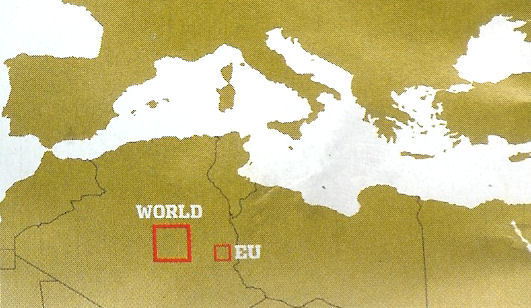
By adopting concentrated solar power north African countries could produce energy and fresh water, two things that are in ever growing demand in that region. 90% of the world's population lives within 3000 miles of hot desert and to supply the worlds energy needs would require 0.3% of that desert. The map below shows the potential for this method of energy production.

More about the plan can be found here and the executive report can be downloaded as a pdf here.
Ref: The Big Issue no 701

As you can see the vast majority of plants on the north African coast are solar and rather than using low efficiency photo-voltaic panels they are using concentrated solar power. This method uses mirrors to direct sunlight onto fluid filled tubes which heat up and are then used to boil sea water. Many of you may remember that boiling water is often considered a good starting point for generating electricity. Boiling sea water is also a major part of de-salination so these plants would produce clean water as a by-product of generating clean electricity. The system is also able to store heat in rocks to continue production at night.
The grid is intended to use high-voltage direct current transmission and it is anticipated that it could transfer energy across 3000 miles (Morocco to mid-European latitudes) with only 15% loss. at about 4p/KWh delivered.
By adopting concentrated solar power north African countries could produce energy and fresh water, two things that are in ever growing demand in that region. 90% of the world's population lives within 3000 miles of hot desert and to supply the worlds energy needs would require 0.3% of that desert. The map below shows the potential for this method of energy production.
More about the plan can be found here and the executive report can be downloaded as a pdf here.
Ref: The Big Issue no 701
Friday, August 04, 2006
Toilet madness
We've been looking for a toilet for a while now - our current one has a leaky cistern, and uses quite a lot of water per flush. It's also 20 years old, and it's huge and ugly.
However, almost all the retailers insist on selling complete bathroom suites - it is generaly more economical to buy a loo, sink and taps (and often a bath too), and then take the bits you don't want to the dump (after all, there is no market in second hand sinks) than it is to get just a toilet on special order. We were looking at toilets that were close to £200, and complete suites for less than that. This is just a crazy situation; it's so wasteful. The sellers try and lure you in with discounts on suites just to make sure consumers waste as many resources as possible.
Luckily, the new B&Q in gillingham now sells 'Toliets to go' for £50. Yup, that's what they call them. It's a complete toilet in a box, with all the cistern fittings etc. And if you just want a cistern float valve or other spares, they'll sell you that too. Amazing - the application of a bit of common sense. Now we've got the almost-as-silly situation where we need to pay a plumber probably double the cost of the loo to install it !
However, almost all the retailers insist on selling complete bathroom suites - it is generaly more economical to buy a loo, sink and taps (and often a bath too), and then take the bits you don't want to the dump (after all, there is no market in second hand sinks) than it is to get just a toilet on special order. We were looking at toilets that were close to £200, and complete suites for less than that. This is just a crazy situation; it's so wasteful. The sellers try and lure you in with discounts on suites just to make sure consumers waste as many resources as possible.
Luckily, the new B&Q in gillingham now sells 'Toliets to go' for £50. Yup, that's what they call them. It's a complete toilet in a box, with all the cistern fittings etc. And if you just want a cistern float valve or other spares, they'll sell you that too. Amazing - the application of a bit of common sense. Now we've got the almost-as-silly situation where we need to pay a plumber probably double the cost of the loo to install it !
Power meter readings
Laptop: 60W
PC: 120W for the CRT monitor, 90W for the base unit
Upstairs Routing hardware: 40W (cable modem, wireless router, Lex PC for linking with work)
Downstairs Routing hardware: 24W (Voip phone, hub, wireless bridge)
The question is, is my 64W x 24hr energy expenditure on homeworking equipment more than what I used to use commuting by train up to london every day ?
PC: 120W for the CRT monitor, 90W for the base unit
Upstairs Routing hardware: 40W (cable modem, wireless router, Lex PC for linking with work)
Downstairs Routing hardware: 24W (Voip phone, hub, wireless bridge)
The question is, is my 64W x 24hr energy expenditure on homeworking equipment more than what I used to use commuting by train up to london every day ?
Monday, July 31, 2006
Consumer solar ?
Currys have started selling solar panels in retain outlets :
http://www.theregister.co.uk/2006/07/31/currys_offer_solar/
Maybe the start of a solar revolution ? We desparately need the price of solar to come down; it's just not affordable for anyone but the very rich at the moment; from a financial point of view it's crazy installing solar panels; you're looking at £10,000 to install enough to knock say £200 per year off your electricity bill. The panels are rated to last about 30 years.
http://www.theregister.co.uk/2006/07/31/currys_offer_solar/
Maybe the start of a solar revolution ? We desparately need the price of solar to come down; it's just not affordable for anyone but the very rich at the moment; from a financial point of view it's crazy installing solar panels; you're looking at £10,000 to install enough to knock say £200 per year off your electricity bill. The panels are rated to last about 30 years.
Monday, July 17, 2006
Power meter
I bought a power meter the other day from Doctor Energy - their customer communications could do with some work but it was only a tenner and turned up within about 2 weeks. It measures current, voltage and power factor, and from that derives total power consumption and cost. So the oxygen generator for Jamie uses about 400 W, the steriliser costs about 1p/day and the phone charger doesn't even register. I'll hook it up to a few different things to see what they use - I'm interested to see what the video and cable box consume when they are on standby; also my intenet gear is on all the time so must gobble up a fair amount over time.
Tuesday, July 11, 2006
Solar anyone ?
Popped out on my bike for half an hour - two things struck me. Firstly, how nice and sunny it was. Secondly, on all of the thousands of new houses around here that heve been put up recently, there was not one with any kind of solar collector on - whether for hot water or photovoltaics. Seeing as the cost for the hot water collectors is only a grand or so it's amazing they don't bother putting them on from new - I'd have thought it was a good selling point that the heating bills will be about half what they would otherwise be.
And yes, I know ultimately the builders don't make that saving so they don't give a damn, but really, it's irresponsible.
And yes, I know ultimately the builders don't make that saving so they don't give a damn, but really, it's irresponsible.
Monday, July 10, 2006
Water usage
Meat production uses an astonishing amount of water. Example: to produce a kilo of beef takes about 50,000 litres of water. Compare that with rice, which takes about 1000 litres, or chicken a mere 4,500 litres. As people are getting wealthier, they are eating more beef,so water demands are going up.
Apparently in the USA, the averge water usage per head is 500litres - in the UK it's 200 and in places like Gambia it's less than 10.
Must get the leak fixed in the header tank...
References:
Counter Currents
The rather shocking Vegetarian Now!
Apparently in the USA, the averge water usage per head is 500litres - in the UK it's 200 and in places like Gambia it's less than 10.
Must get the leak fixed in the header tank...
References:
Counter Currents
The rather shocking Vegetarian Now!
Sunday, July 09, 2006
Travel by train
I recently discovered a fantastic site for anyone who wants to travel abroad but doesn't want to fly. The site is called "The man in seat 61" and gives vast amounts of info on how to travel from the UK to places all across Europe and the rest of the world by train and ship. There are lots or reasons to avoid flying: -
Two such companies are: -
CO2Balance.com
The CarbonNeutral Company
(They take part in various carbon reduction schemes and also sell a range of environmentally friendly gifts and gadgets.)
- It creates a lot of pollution.
- Some people are afraid of flying (although it is very safe).
- Some people feel the journey is as important as the destination and an adventure in it's own right.
- Lining up at the baggage check in followed by hours sitting in an airport then spending hours in a plane being served vile food while trying to avoid DVT and having the seat in front slowly crush your kneecaps only to have to make your way through passport control and then finding your luggage took a much more luxurious trip than you to a different continent IS NOT FUN.
Two such companies are: -
CO2Balance.com
The CarbonNeutral Company
(They take part in various carbon reduction schemes and also sell a range of environmentally friendly gifts and gadgets.)
Friday, July 07, 2006
Green electricity
About 2 years ago I signed up with Juice. Juice is an electricity tarrif from npower. It costs their same as their standard tarrif but is produced from 100% renewable sources (mostly offshore wind farms like North Hoyle). It is also run in partnership with Greenpeace who ensure that the 100% renewable agreement is adhered to. They also give £10 a year for every Juice customer to renewable energy research projects.
I personally feel that the best future for electricity generation is decentralised generation by homes, offices, etc across the country. However it will take a while to happen and for people to save up for roof mounted solar panels and wind turbines. In the meanwhile signing up to one of the many green electricity providers is a good alternative.
I personally feel that the best future for electricity generation is decentralised generation by homes, offices, etc across the country. However it will take a while to happen and for people to save up for roof mounted solar panels and wind turbines. In the meanwhile signing up to one of the many green electricity providers is a good alternative.
Washing
We bought a washing machine recently - we ended up with a Bosch one, mainly because it used 11 litres less water per wash than the hotpoint one. It also uses less electricity - and seems to wash a bit better than our old hotpoint as well. Sharon spent quite some time crawling round the floor in the showroom trying to read the efficiency data on each model; why don't they stick that data on the top ?!
It's getting good usage now - Jamie gets through quite a lot of nappies, and even factoring the cost of the washing machine into account, we should break even inside 2 years now that we have reusable nappies.
It's getting good usage now - Jamie gets through quite a lot of nappies, and even factoring the cost of the washing machine into account, we should break even inside 2 years now that we have reusable nappies.
Portable Solar
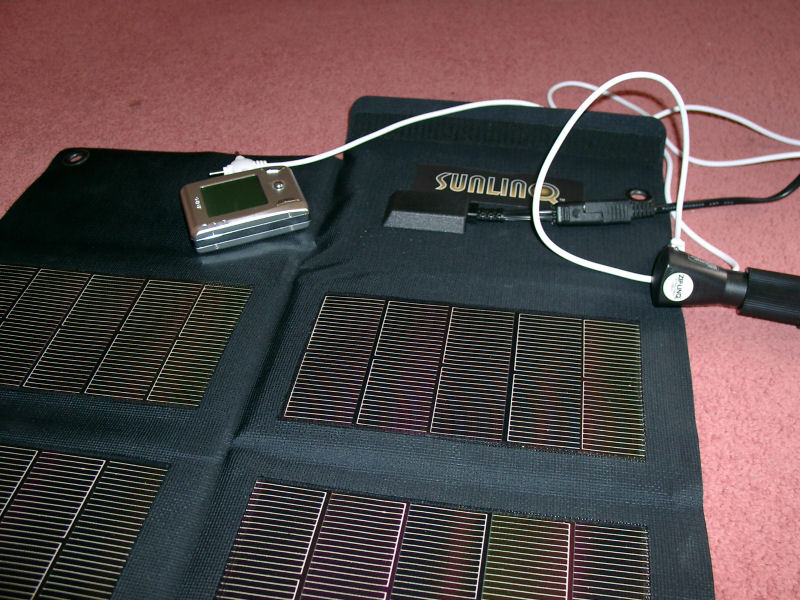
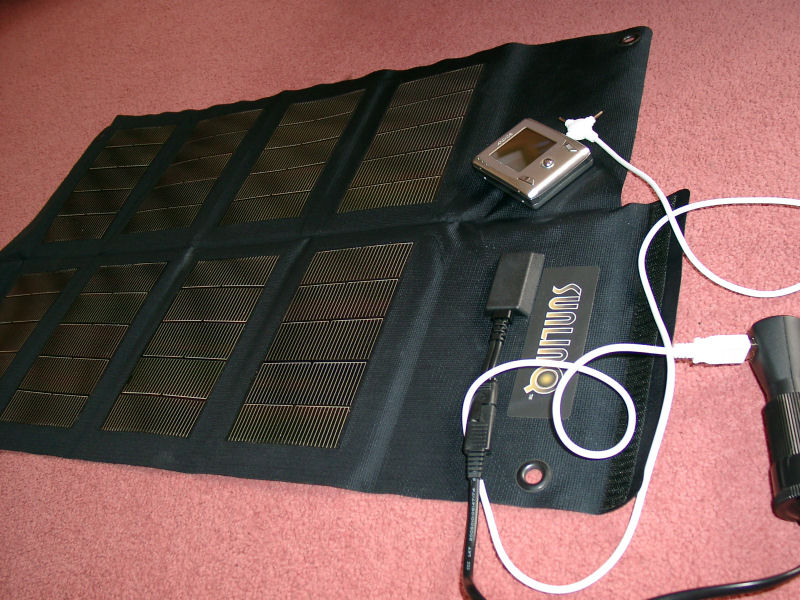
I recently bought a sunlinq set of solar panels with the idea of recharging various gadgets (GPS, MP3 player, phone, AA batteries, etc) when I was away from home and had no access to mains. The solar panels are light, flexible, waterproof and very durable they also fold down to the size of a thin book. The come with a range of of adapters including clips and a female car lighter socket which when combined with a 12v dc to 5v usb adapter can charge virtually any gadget you care to name. Unfortunately it is pretty expensive but comes in a range of sizes and costs (I went for the 12 watt one)
More info can be found here and a UK supplier can be found here.
Here are some pics: -


More info can be found here and a UK supplier can be found here.
Here are some pics: -
More Books
This is a book with lots of simple tips for reducing your impact on the environment while often saving money.
Saving The Planet Without Costing The Earth
For those who are a little more hardcore in their environmentalism this book explains how to build a house that from building materials to energy generation and water collection and re-use will have virtually no impact on the Earth at all!
Earthship: How To Build Your Own
More info here
Saving The Planet Without Costing The Earth
For those who are a little more hardcore in their environmentalism this book explains how to build a house that from building materials to energy generation and water collection and re-use will have virtually no impact on the Earth at all!
Earthship: How To Build Your Own
More info here
Wednesday, July 05, 2006
Passive solar design
A book about keeping your house at a sensible temperature regardless of the weather:
The Solar House: Passive Heating and Cooling
The Solar House: Passive Heating and Cooling
House cooling
Nick asked,"What is the most acceptable way of cooling down a house?"
I think the most acceptable way is to stop it getting hot in the first place! My shed now has foil-backed bubble wrap inside the roof and on the windows, which reflects heat back out - between the foil and the roof the temperature was about 46 degrees; in the shed it was a mere 30 degrees while the outside temperature was 27 degrees. In our baby's room I've put the same stuff on the windows (kitchen foil would do), as well as a blackout blind, plus we keep all the curtains shut on the side of the house that gets the sun. Oh, and open windows on both sides of the house to get a breeze through - even if there's no wind you should get a bit of movement through convection.
After that, paint the roof white (ideally silver), grow tall trees on the north and west sides, face the house south and have minimal size windows on the west side, use shutters and have an overhang over all the windows to reduce the heat coming in in the middle of the day. Um, not too practical for a rented house though :-)
I think the most acceptable way is to stop it getting hot in the first place! My shed now has foil-backed bubble wrap inside the roof and on the windows, which reflects heat back out - between the foil and the roof the temperature was about 46 degrees; in the shed it was a mere 30 degrees while the outside temperature was 27 degrees. In our baby's room I've put the same stuff on the windows (kitchen foil would do), as well as a blackout blind, plus we keep all the curtains shut on the side of the house that gets the sun. Oh, and open windows on both sides of the house to get a breeze through - even if there's no wind you should get a bit of movement through convection.
After that, paint the roof white (ideally silver), grow tall trees on the north and west sides, face the house south and have minimal size windows on the west side, use shutters and have an overhang over all the windows to reduce the heat coming in in the middle of the day. Um, not too practical for a rented house though :-)
Tuesday, July 04, 2006
Aircon ?
Aircon isn't particularly environmentally friendly, but running it in reverse to do heating can be, as you are moving thermal energy from outside to inside rather than converting it directly from the electricity supply. Finally someone has released a device that works both ways, and doesn't have a stupid price tag.
Tony pointed out that if you have a wind turbine, this would be a completely free way to heat your house, particularly at night when it is often a) cold, b) windy c) you don't have anything much using electricity .
Tony pointed out that if you have a wind turbine, this would be a completely free way to heat your house, particularly at night when it is often a) cold, b) windy c) you don't have anything much using electricity .
Windsave
Windsave are doing mini wind turbines to fit on your roof for about £1500 - they generate 1Kw in a stiff breeze and thanks to some new planning laws are fairly simple to get approval for. When we get our big house in the country (ie, about 30years after I'm dead at current progress) maybe we'll get a couple.
Subscribe to:
Posts (Atom)