Huraah!!! I have finally replaced the last incandescent bulb in my house. The reason I took so long is that it was connected to a dimmer switch which have been a real problem for low energy bulbs. Homebase have finally started selling dimmable low energy bulbs made by a company called Varilight.
The bulb was a lot more expensive than an ordinary low energy bulb (£11.99) but I had wanted to replace the incandescent bulb for a long time and I expect the price will start to drop sooner or later. The bulb works pretty well with the dimmer although it take a significant fraction of a second to adjust so if you change the dimmer to quickly the light increases or decreases in sudden steps.
Overall the bulb is good but I think the price needs to come down before they'll really start selling.
Saturday, March 08, 2008


Monday, March 03, 2008
Cool Looking Zero Emission Car!!!!!
The subject of why alternative fuel source cars look like plastic bricks has come up a few times on this blog. Antony is particularly passionate about the subject, often flying into extreme rants and demanding answers that we all want. This post should provide warm fuzzy feelings and calm all of our doubts about whether a cool looking car can be ever be environmentally friendly.
That great manufacturer of classic cars Morgan has developed a new vehicle it has called the Morgan Life Car (to be unveiled this month at the Geneva Motor Show). The Life Car motor is powered by hydrogen fuel cells and so only emits water. The Life Car itself however emits an look of classic elegance and style. The specs are not too bad: -
22KW motor
150 mpg
250 miles per tank
0-60mph in 7 seconds
100mph top speed.
50% energy recovered from regenerative braking
The Morgan Page is here
The BBC story is here
Now the pics


That great manufacturer of classic cars Morgan has developed a new vehicle it has called the Morgan Life Car (to be unveiled this month at the Geneva Motor Show). The Life Car motor is powered by hydrogen fuel cells and so only emits water. The Life Car itself however emits an look of classic elegance and style. The specs are not too bad: -
22KW motor
150 mpg
250 miles per tank
0-60mph in 7 seconds
100mph top speed.
50% energy recovered from regenerative braking
The Morgan Page is here
The BBC story is here
Now the pics


Wednesday, February 13, 2008
Air Powered Car pt2
I while ago I posted a story about a French design for a compressed air powered car read it here.
BBC news have done a story on the development. The car should be on sale within a year and may cost as little as £2500 for a 5 seater. It can be refueled from a compressor in 3 minutes or plugged into a domestic supply overnight and refuel with an onboard compressor in 4 hours. It can also burn various liquid fuels to preheat the air increasing it's range.
The company MDI is planning a range of products from sales of the actual motors, through a range of small cars and even including buses. Their website can be found here.
Read the BBC story here.
Here is an artist's impression of one of the small car models.

BBC news have done a story on the development. The car should be on sale within a year and may cost as little as £2500 for a 5 seater. It can be refueled from a compressor in 3 minutes or plugged into a domestic supply overnight and refuel with an onboard compressor in 4 hours. It can also burn various liquid fuels to preheat the air increasing it's range.
The company MDI is planning a range of products from sales of the actual motors, through a range of small cars and even including buses. Their website can be found here.
Read the BBC story here.
Here is an artist's impression of one of the small car models.

Cycling in London
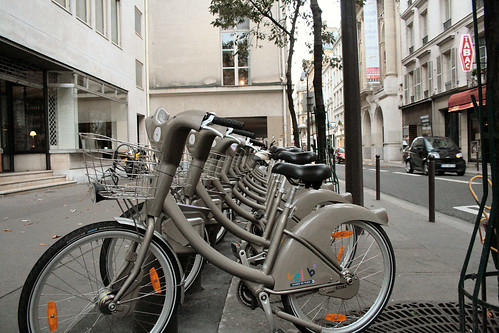
London is about to receive a £500 million investment towards improving cycling in the city. The scheme will include 6000 hire bikes. These will be available from docking stations where users of the scheme can unlock them, use them and then place them in another docking station when they are finished. This is similar to the Velib scheme in Paris shown below.

The scheme will also include 12 new cycling routes as well as clearly marked bike zones linking parks, waterways and key destination around the city. The aim is 5% of all journeys in London being made by bike by 2025. Personally I think that 5% in 17 years is pretty unambitious and that it will take a hell of a lot more than £500m to change the way Londoners travel. However I have seen the system in Paris and it was very popular so it may take off (assuming Londoners don't steal or vandalise all of the bikes).
The scheme will also include 12 new cycling routes as well as clearly marked bike zones linking parks, waterways and key destination around the city. The aim is 5% of all journeys in London being made by bike by 2025. Personally I think that 5% in 17 years is pretty unambitious and that it will take a hell of a lot more than £500m to change the way Londoners travel. However I have seen the system in Paris and it was very popular so it may take off (assuming Londoners don't steal or vandalise all of the bikes).
Thursday, February 07, 2008
Renewable Suber Grid pt2
In August 2006 I wrote a post about a plan for a renewable energy super grid covering Europe and North Africa read it here.
The plan is now going ahead. The company behind this is the Trans-Mediterranean Renewable Energy Company (TREC). The plan is to build commercial concentrated solar power stations in North Africa that would sell electricity to Europe while simultaneously desalinating sea water as a by product of energy production.
Germany and Algeria have already reportedly signed a deal to lay cables stretching as far north as Aachen on the German-Belgian border. read more here.
The plan is now going ahead. The company behind this is the Trans-Mediterranean Renewable Energy Company (TREC). The plan is to build commercial concentrated solar power stations in North Africa that would sell electricity to Europe while simultaneously desalinating sea water as a by product of energy production.
Germany and Algeria have already reportedly signed a deal to lay cables stretching as far north as Aachen on the German-Belgian border. read more here.
Sunday, January 20, 2008
Excuse me my good man this wine is errr.....bagged.
One of the areas of environmental concern that is thankfully gaining increased attention is the carbon footprint of food production and distribution. Many producers are now starting to reduce packaging in their products while retailers are starting to make more local produce available (there is still a very long way to go but it is a start). Now changes are coming to that most traditional and civilised of packages, the wine bottle.
Australian producer Wolf Blass have started to use PET plastic bottles while Banrock Station are using my least favourite packaging the infamous Tetra Pak. However the prize for ingenious packaging must go to Arniston Bay with their resealable bag. They claim the bag uses 80% less of a carbon footprint than glass bottle. It also uses 90% volume in landfill (for those too damn lazy to recycle) and can be taken to public events where glass is not allowed. All this may be true, it may also be a good thing but it does not bode well for the traditional images of the snooty wine waiter, the dust covered bottle in a musty wine cellar, the scrunch of a champagne bottle in a silver ice bucket or the homeless person reduced to drinking blue nun or black tower from a bottle inside a brown paper bag. Oh well here is a picture: -

Australian producer Wolf Blass have started to use PET plastic bottles while Banrock Station are using my least favourite packaging the infamous Tetra Pak. However the prize for ingenious packaging must go to Arniston Bay with their resealable bag. They claim the bag uses 80% less of a carbon footprint than glass bottle. It also uses 90% volume in landfill (for those too damn lazy to recycle) and can be taken to public events where glass is not allowed. All this may be true, it may also be a good thing but it does not bode well for the traditional images of the snooty wine waiter, the dust covered bottle in a musty wine cellar, the scrunch of a champagne bottle in a silver ice bucket or the homeless person reduced to drinking blue nun or black tower from a bottle inside a brown paper bag. Oh well here is a picture: -

Thursday, January 10, 2008
new battery tech
Silicon nanowires have been used in a lithium battery to increase the capacity by a factor of ten - should lay waste to the 'milik float' arguement against electric cars.
Wednesday, November 28, 2007
hybrids, solar and google
Google are getting into the renewable energy market by investing (through google.org) in solar, and in hybrid cars.
here's a link to the stats on one of their hybrid cars - this one has been fitted with an extra battery to improve performance.
http://www.google.org/recharge/dashboard/car?car=Machu%20Picchu&evy=3&evd=20071128&evt=000000
Note the MPG is a rather pathetic 54.4 - which is about what we get from our petrol C2. Shockingly the average MPG for an american car is 19.8 - this presumably is why the americans think the Prius is great, where as the rest of the world views it as a waste of space, or more charitably, a testing ground for mass production and marketing of electrically powered cars. Some little diesels can get at least /double/ the milage without the complication and cost of having batteries and generators on board.
here's a link to the stats on one of their hybrid cars - this one has been fitted with an extra battery to improve performance.
http://www.google.org/recharge/dashboard/car?car=Machu%20Picchu&evy=3&evd=20071128&evt=000000
Note the MPG is a rather pathetic 54.4 - which is about what we get from our petrol C2. Shockingly the average MPG for an american car is 19.8 - this presumably is why the americans think the Prius is great, where as the rest of the world views it as a waste of space, or more charitably, a testing ground for mass production and marketing of electrically powered cars. Some little diesels can get at least /double/ the milage without the complication and cost of having batteries and generators on board.
Wednesday, October 24, 2007
Gas Fire
Our gas fire broke last winter and we've just got round to thinking about getting it replaced. Gas is more efficient than electricity for heating, as the combustion is done at the point of use. Power stations on the other hand use heat to turn water into stream, drive turbines which drive generators, which send electricity down miles of cable just for you to turn it back into heat again. The generators are typically 40-60% efficient, and a further 6-8% or more is lost in the power cables and substations. (see here for more info)
Clearly then, the sensible choice is for us to replace our gas fire with an electric one and just not use it. We've been quoted £1600 + £400 installation for a gas fire, and £200 all up for an electric one. This includes a fireplace and mantle (£700 for the gas one). This isn't just about choosing the one that is most efficient, or makes most financial sense - this is about not actually owning sufficient money to buy the environmentally more friendly option.
Clearly then, the sensible choice is for us to replace our gas fire with an electric one and just not use it. We've been quoted £1600 + £400 installation for a gas fire, and £200 all up for an electric one. This includes a fireplace and mantle (£700 for the gas one). This isn't just about choosing the one that is most efficient, or makes most financial sense - this is about not actually owning sufficient money to buy the environmentally more friendly option.
Tuesday, September 25, 2007
Hanbury Hall and the national trust
The national trust are going all green - as a conservational body they approve of the idea of reducing their impact on the environment, so they are starting a number of 'green' initiatives. One of which is a green energy tarrif in association with npower. Another is using renewables where possible.
I spotted this anomoly at Hanbury Hall - I couldn't find out much about it, but it does look rather incongruous seeing the ultra modern thin film solar panels, mounted on a 300 year old wall in front of a 500 year old house:

I /think/ its for powering a fountain - if anyone figures it out for sure, let me know !
I spotted this anomoly at Hanbury Hall - I couldn't find out much about it, but it does look rather incongruous seeing the ultra modern thin film solar panels, mounted on a 300 year old wall in front of a 500 year old house:

I /think/ its for powering a fountain - if anyone figures it out for sure, let me know !
Friday, September 14, 2007
The last horse finally crosses the finishing line
According to Professor John Marburger scientific advisor to President Bush, climate change is almost certainly due to the activities of mankind and we need to start reducing CO2 emissions. President Bush is going to invite leaders from major nations to the White House this month to discuss the problem.
Thanks for the timely response guys.
Find out more about Professors Marburger's cutting edge look into established facts and the painfully obvious here.
Thanks for the timely response guys.
Find out more about Professors Marburger's cutting edge look into established facts and the painfully obvious here.
Friday, August 31, 2007
US energy policy
According to this, Carter came up with a energy policy proposal in 1979, specifically to prevent the US from having to go to war with the middle east to secure oil. Naturally it was opposed by many, and led to the bin Laden family essentially getting Bush2.0 in as the presedent.
oil subsidies
Just found this article detailing the extent of the US oil subsidies. It boils town to tax breaks - the oil industry gets taxed at 11%, other industries at 18%, which if you do the math comes out to about $6billion. This clearly doesn't square with the $16billion mentioned below - which demonstrates the saying that there are lies, damned lies and statistics :-)
Wozniak Green Plans
Steve Wozniak, of Apple fame, is jumping on the green bandwagon in a big way. He's discovered the idea of building homes that require little or no power to heat. Some of his ideas are a little misguided (eg, he suggested in an interview that one should knock down energy inefficient housing and replace it with shiney efficient housing - neatly ignoring the aount of energy required to build a home, not to mention the landfill required to dispose of the old one), but it's excellent that someone in his position has publicly declared energy efficiency to be a Good Thing&tm;, particularly as there is a certain class of Apple customer who will do everything the Steves tell them to :-)
One facinating idea he's come across (and no doubt will invest in) is that of using a particular wood for your core building material. Southern Yellow pine has sap that melts at about 22C, so as the external temperature rises above that, an enormous amount of energy is absorbed by the wood to melt the pine - keeping the internal temperature down. Neat idea - there's a few complications that I see - eg, sap tends to dry out over time, so it may lose effectiveness over time. Also, many people are allergic to pine sap, and as it evaporates (which surely it must if it becomes liquid) the house is going to be infused with vapourised sap. Not so good. Perhaps a synthetic version could be produced, with the working fluid sealed inside the structure of the building.
One facinating idea he's come across (and no doubt will invest in) is that of using a particular wood for your core building material. Southern Yellow pine has sap that melts at about 22C, so as the external temperature rises above that, an enormous amount of energy is absorbed by the wood to melt the pine - keeping the internal temperature down. Neat idea - there's a few complications that I see - eg, sap tends to dry out over time, so it may lose effectiveness over time. Also, many people are allergic to pine sap, and as it evaporates (which surely it must if it becomes liquid) the house is going to be infused with vapourised sap. Not so good. Perhaps a synthetic version could be produced, with the working fluid sealed inside the structure of the building.
Monday, August 06, 2007
Oil industry in US
Finally, the oil industry is getting attention from the US government. For all those people who bleat on about the millions of pounds of subsidy that renewable energy companies receive, here's an extract from the BBC news site today:
Sixteen billion dollars is quite a lot of money, though a tiny fraction of what has been spent invading the middle east in recent years to support America's oil addiction.
"The draft law details support for "clean" energy sources like biofuels, wind, solar and geothermal resources. It would withdraw some $16bn (£8bn) in annual subsidies from the oil industry."
Sixteen billion dollars is quite a lot of money, though a tiny fraction of what has been spent invading the middle east in recent years to support America's oil addiction.
Sunday, July 22, 2007
Wind Power For Campers
I recently made a post on this blog about inflatable wind turbines. Trudy commented that it would be nice if there was a smaller version for campers. Orange clearly thought the same thing and commisioned a prototype tent mounted wind generator. The resulting device charges up a battery which in turn can charge up another device. Here's a picture: -


- The good news is that it only weighs 150 grammes.
- The bad news is that to generate enough energy to fully charge a mobile requires 24 hours of 12mph wind (I guess it won't run a cool box).
Wednesday, June 13, 2007
Tesco improves carrier bag policy
Tesco have improved their drive to reduce plastic carrier bag use. They have finally realised that there is no point in including carrier bags in home deliveries that already come in tough reusable crates and now offer delivery without them. I am a little surprised that it took them this long to work that out but well done all the same.
In the mean time I have signed up with Abel & Cole that deliver all of their food in re-usable boxes that are collected by the delivery guy next time they arrive. (I hope you enjoyed the wine Tony).
In the mean time I have signed up with Abel & Cole that deliver all of their food in re-usable boxes that are collected by the delivery guy next time they arrive. (I hope you enjoyed the wine Tony).
Wednesday, April 25, 2007
Inflatable wind turbines!!!
A company in Canada called Magenn Power have developed a lighter than air inflatable wind turbine called MARS (Magenn Air Rotor System). I love conventional wind turbines and hope to see many more spring up across the country (especially outsde the homes of countryside alliance members). However they are not exactly portable. The Magenn system would allow a 4KW turbine to be packed into the boot of a family hatchback and be deployed anywhere with speed and ease. They are planning version capable of 1-2MW. These can be used for anything from the supply for a small town to power for emergency aid locations. They also have little or no chance of killing birds because they have no long blades and they are bouncy. Magenn's website is here.
Now for the picture: -

Now for the picture: -

Solar powered sausages
Spring has arrived with a vengance and summer is clearly not far behind. With such wonderful weather many people are starting to have barbeques. While I will gladly admit that charcoal and gas powered barbeques are not that important in the grand scheme of planetary climate change it is still possible to take the green option. The technology for solar cookers is not new or complicated and has been used in countries around the world. This is useful in places where firewood is scarce and it also removes smoke from cooking fires which kills millions every year. However this is the first time I have seen a solar cooker targetted at the European barbeque market. A Swiss company have prduce a solar grill based on a simple parabolic mirror. It requires no gas, wood or charcoal only a reasonably sunny day (which we get even in the UK). It is also reasonably priced (about £120 plus postage and packing). You can find out more and order here.
Now for the picture: -

Now for the picture: -

Tuesday, April 24, 2007
Lightbulbs
Looks like the government is on the right track on this one - they are proposing a lower rate of VAT for energy efficient products. Here's the response to the on-line petition regarding low energy lightbulbs
Subscribe to:
Posts (Atom)